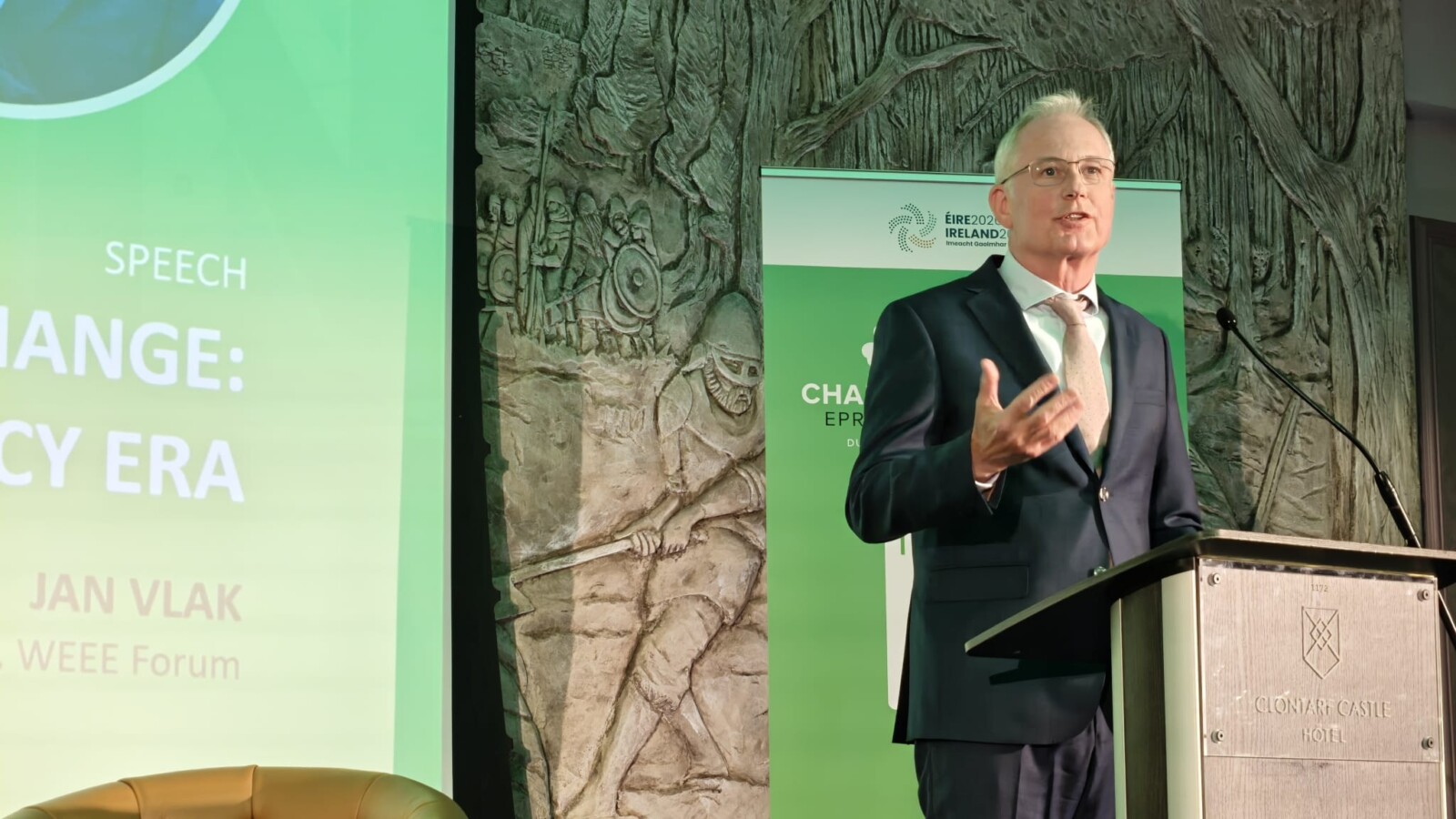
The responsibility for waste electrical and electronic equipment should be broadened from producers to all actors in the value chain. That was the key message delivered by Jan Vlak, Managing Director of Stichting OPEN and President of the WEEE Forum, during his keynote speech at the international conference From Challenge to Change in Dublin.
According to Vlak, over the past twenty years Europe has built an impressive collection system for e-waste based on Extended Producer Responsibility (EPR). The next step, he argues, is to ensure that all actors in the value chain take responsibility for the collection and responsible treatment of e-waste. Vlak is therefore calling for a shift from producer responsibility towards societal responsibility.
Almost half remains unaccounted for
The European approach has achieved a great deal. Producers finance collection systems, municipalities and retailers provide collection opportunities, and specialised companies ensure that products are reused and recycled into new raw materials. Together, these actors have created a comprehensive ecosystem.
Yet a large share of waste electrical and electronic equipment still remains outside the official channels. A recent evaluation by the European Commission found that 46% of e-waste generated in the EU is not separately collected and therefore remains unaccounted for.
According to Vlak, this is more than just a waste management issue. Discarded electrical and electronic equipment contains valuable and critical raw materials such as copper, aluminium, cobalt and rare earth elements. Vlak: “How can we secure access to critical raw materials if we cannot account for almost half of the products from which those materials could be recovered?”
The ‘All Actors’ principle
According to Vlak, the system has become more complex than the legal framework established twenty years ago. Once a product reaches the end of its life, it can be collected, traded, transported, reused or treated by a wide range of actors.
That is why he is calling for the ‘All Actors’ principle: all parties that have access to e-waste should also bear responsibility for its proper management. This does not mean that all actors should have the same responsibilities, nor does it mean that producers should no longer be responsible. Producers must retain their financial and organisational responsibilities. But other actors involved in the chain should also be subject to legal obligations.
In the Netherlands, such an approach could lead to higher collection rates, according to Vlak. As an example, he referred to a mandatory handover requirement for businesses, which is estimated to make around 35 million kilograms of additional e-waste available for proper collection and treatment. Stichting OPEN has therefore been advocating such a requirement in the Netherlands for some time.
Towards Extended Societal Responsibility
Vlak also called for better monitoring of all e-waste flows, more realistic collection targets, greater emphasis on high-quality treatment and an approach that takes consumer and business behaviour into account. He stressed that the solution is not to scale back Extended Producer Responsibility (EPR). On the contrary, according to Vlak, EPR has laid the foundation for the current European system. The next step is to build on that foundation. Vlak: “The next phase is EPR plus the ‘All Actors’ principle: a transition from Extended Producer Responsibility to Extended Societal Responsibility.”
His message is therefore clear: “Producers built the system, but the system can only function fully if every actor involved in e-waste takes responsibility.”
About the WEEE Forum
The WEEE Forum is the international association for organisations that implement Extended Producer Responsibility (EPR) at national level and serves as an international centre of expertise on waste electrical and electronic equipment (WEEE). The WEEE Forum has 50 members: producer responsibility organisations from around the world. Jan Vlak, Managing Director of Stichting OPEN, is President of the WEEE Forum.
About the conference in Dublin
The WEEE Forum conference From Challenge to Change brought together experts from around the world in Dublin, Ireland, on 17 and 18 September to discuss the challenges and opportunities surrounding e-waste. Bruno Vermoesen (BSH Home Appliances and board member of Stichting OPEN) also participated in the conference as a panellist.
More information about the WEEE Forum and the conference can be found on the WEEE Forum website.