 Continue reading
·
Reading time: 1
min
JAROCELLS: Extended Producer Responsibility (EPR) and more
Extended Producer Responsibility (EPR) is a legal obligation for companies that place appliances, lamps, or batteries on the (Dutch) market. For JAROCELLS, however, it is primarily a natural part of professional business practice.
JAROCELLS is a family-owned company with a deep-rooted passion for technology and sustainability. For the past 13 years, the company has been developing and installing advanced lithium batteries. But its mission goes beyond technology alone: making sustainable energy accessible to everyone, regardless of location or ambition.
Joining EPR: a logical step
Extended Producer Responsibility for appliances, lamps, and batteries was not seen as an administrative burden by JAROCELLS, but as a logical step.
“For us, EPR is inseparably linked to professionalism. When we expanded years ago, we wanted to operate immediately according to the highest standards. Joining Bebat in Belgium and Stichting OPEN in the Netherlands was therefore self-evident. As a serious market player, you must take responsibility for the (end-of-life phase of the) products you place on the market.”
Lithium batteries contain reusable raw materials. Considering them as waste simply feels unnatural to the company. By participating in collective systems, these materials are reintroduced into the supply chain through high-quality recycling. In their view, EPR is not only a legal obligation, but also an essential instrument in the circular economy.
Actively informing customers about sustainability
JAROCELLS considers it important to actively inform customers about sustainability and its participation in EPR systems.
Communication takes place through multiple channels:
-
The website and social media channels
-
Personal conversations with customers
-
Dealers and distributors, who play a key role
-
A periodic newsletter covering current sustainability topics
In one of the upcoming editions, Dutch dealers will, for example, be actively informed about the opportunities offered by Wecycle voor Bedrijven. In this way, the company not only increases its own impact but also helps partners further improve the sustainability of their operations and dispose of discarded appliances, lamps, and batteries free of charge, safely, and circularly.
Sustainability from design to logistics
At JAROCELLS, sustainability does not stop at the point of sale; it is embedded throughout the entire business operation. Packaging materials that arrive in good condition are immediately reused for shipping chargers and accessories — a straightforward yet effective approach that fits the character of a family business.
The batteries are designed for a long service life and can be properly repaired in the company’s own workshop. Spare parts remain available for extended periods, minimizing waste. The company building is gas-free (energy label A+++) and runs on solar panels with its own battery storage system. In logistics, conscious choices are made, such as purchasing in large volumes and delivering electrically within the region.
Safe handling of discarded batteries
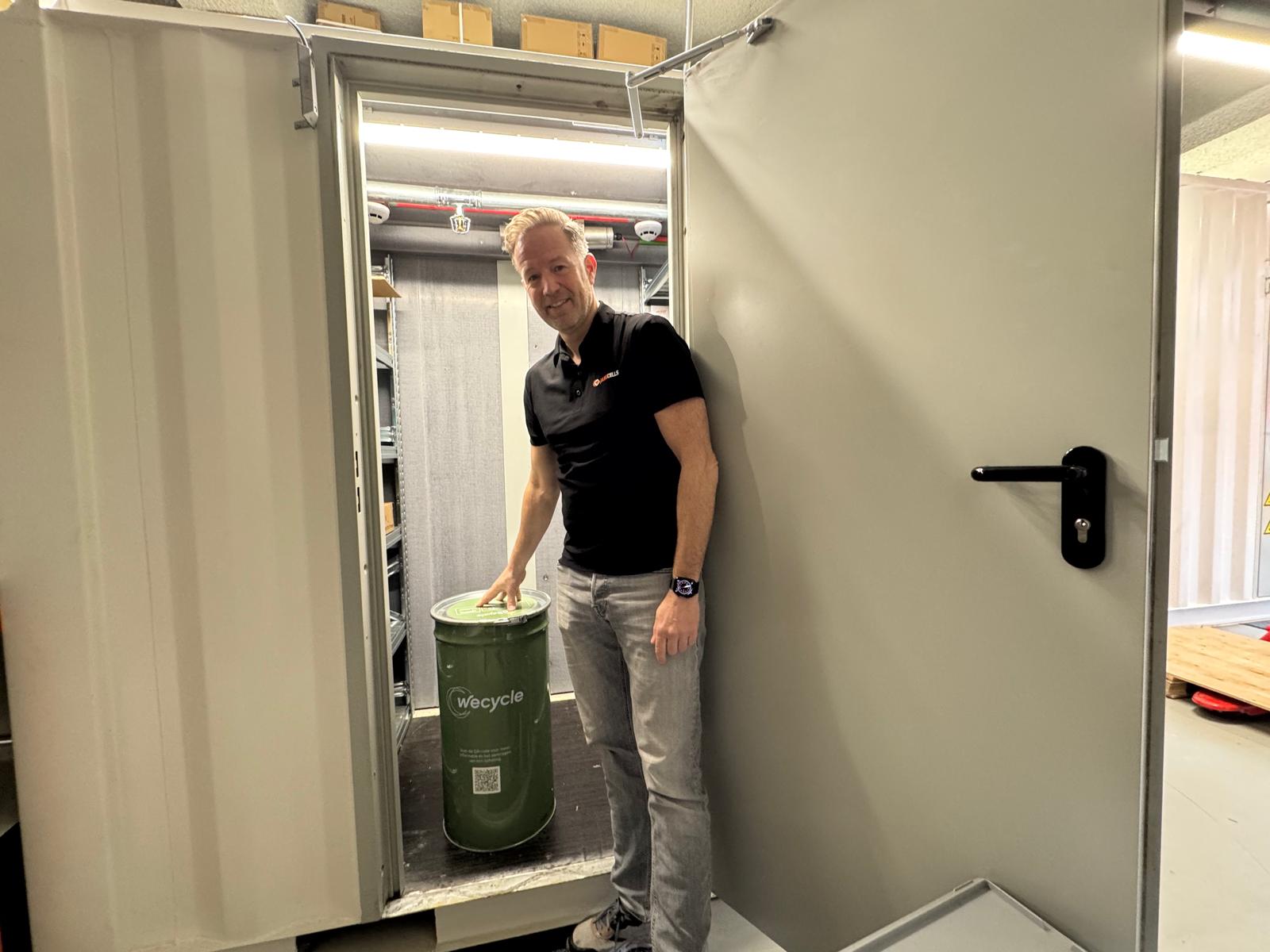
The company has invested in innovative storage containers for both new and used batteries, ensuring safety for people and the environment. Customers often return their old batteries when switching to JAROCELLS. Even when these products were not originally supplied by JAROCELLS, the company takes its role as a collection point seriously.
Workshop procedures are strictly regulated. Technicians fully discharge batteries to minimize energy-related risks during transport. The products are packaged in accordance with regulations in plastic bags or anti-static film. The batteries are then stored in a special collection container that is periodically collected by Stichting OPEN.
Through this careful process, JAROCELLS ensures that discarded batteries are disposed of safely and given a “second life” as raw materials through high-quality recycling.
Photo: JAROCELLS